
10 October 2026
Do You Need Planning Permission For Commercial Solar In Greater Manchester?
Planning permission for commercial solar in Greater Manchester: Class J roof rules, conservation areas, ground mounts, carports, batteries and councils.
For most factory, warehouse and office roofs in Greater Manchester, the answer is no. Rooftop solar on a non-domestic building is permitted development under Class J of the planning rules, and since 21 December 2023 there’s been no 1MW ceiling on it. Systems above 50kW do need prior approval, a lighter process in which the council looks only at design, appearance and glare and has 56 days to decide. The picture changes for listed buildings, for ground-mounted arrays bigger than 9 square metres, and for battery storage, which has no permitted development class at all. Greater Manchester has more of those edge cases than most regions. Ancoats has been a conservation area since 1989, and Castlefield since 1979. This guide explains when you need planning permission for commercial solar in Greater Manchester, which council to deal with, and what else needs signing off before the panels go up.
The short answer for most factory and warehouse roofs
Permitted development means the government has already granted planning permission for a type of work, as long as it stays within set limits. For solar on buildings that aren’t homes or flats, those limits are in Class J of Part 14 of the General Permitted Development Order.

Class J splits rooftop solar into two groups. Microgeneration, which means up to 50kW, can go ahead without any application if it meets the limits. Anything bigger falls under Class J(c), “other solar PV equipment on the roof”, and needs prior approval before work starts. On a typical portal-frame distribution shed, that’s the route most projects follow.
So the honest planning answer for a shed on Trafford Park, Agecroft Commerce Park or Martland Park is usually short. The harder questions are structural and electrical, which we cover on our page about commercial solar panels for Greater Manchester businesses.
The Class J limits, line by line
The rules are in the General Permitted Development Order, Part 14, and they’re more practical than they first look.
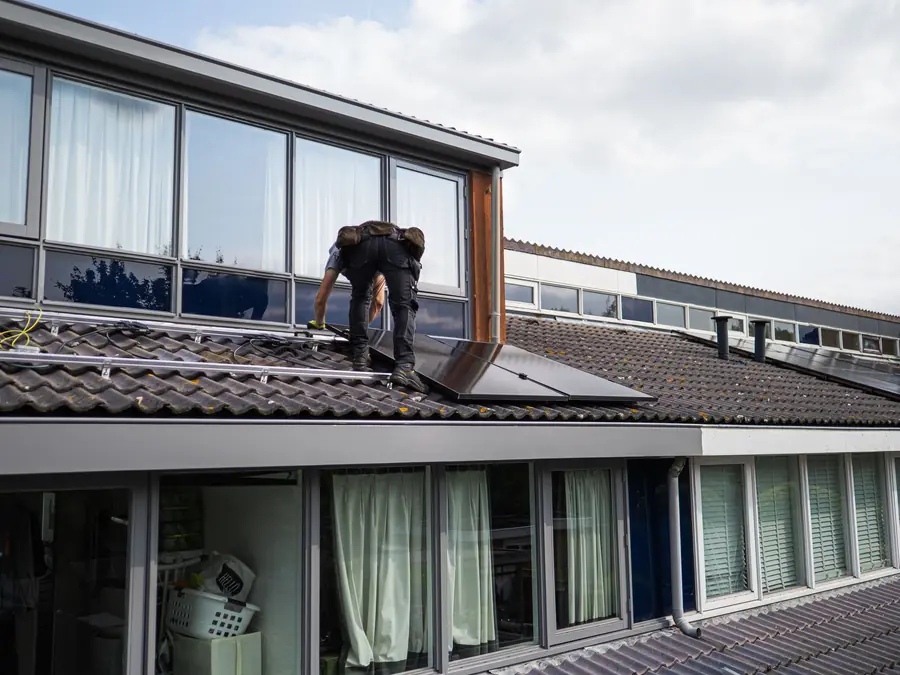
On a pitched roof, the equipment can’t stick out more than 0.2 metres beyond the plane of the roof slope. On a flat roof, its highest point can’t sit more than 1 metre above the highest part of the roof. Either way, nothing can be within 1 metre of the roof’s external edge. There’s also a general condition that panels are sited, as far as practicable, to keep down their effect on the building’s appearance and the surrounding area.
Prior approval for systems over 50kW covers design, external appearance and glare. That last one is worth thinking about early if your site sits near a busy road, housing or an airfield, since reflective glare is exactly what the council will be checking. A layout that keeps panels away from sightlines can save a round of questions.
The 2023 changes widened things further. The same order that removed the 1MW cap added a new class for solar canopies over car parks and amended several others. Nothing we’ve found in the 2026 changes alters Class J for non-domestic buildings.
Listed buildings, conservation areas and Manchester’s mills
Class J doesn’t apply to a listed building or a scheduled monument, or within their curtilage. If your premises are listed, you’ll need planning permission and listed building consent, and the case for panels has to be made properly.

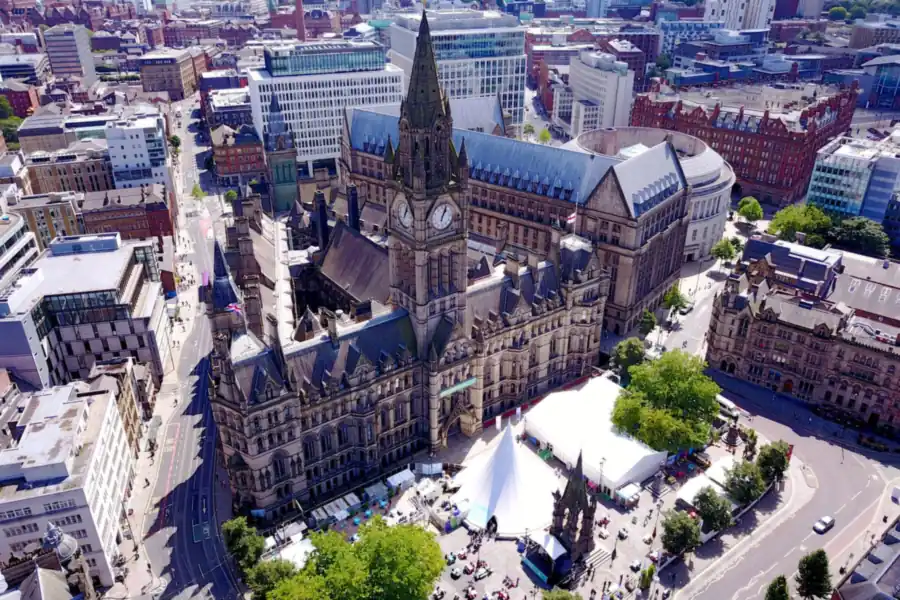
That matters more in Manchester than in most cities. Ancoats, called the world’s first industrial suburb, has mills dating from about 1790, and parts of Murrays’ Mills are Grade II* listed. Castlefield, the Deansgate and Peter Street area and Whitworth Street are all conservation areas full of converted warehouses and offices.
Conservation areas are a subtler case. The Class J wording doesn’t exclude roof-mounted equipment in conservation areas across the board, although wall-mounted panels facing a highway there are ruled out. We’d still always confirm with the council before treating a conservation-area roof as permitted development.
For most industrial sites none of this applies. No conservation area covers Trafford Park, Salford Quays, Port Salford or Northbank Industrial Park at Irlam. Manchester has none over Cheetham, Strangeways, Openshaw, Beswick or the Wythenshawe estates. Wigan’s town centre conservation area dates from 1980 but takes in the centre, not Martland Park or Wheatlea.
Ground-mounted arrays and solar carports
Ground mounts are where permitted development runs out quickly. Class K allows one stand-alone microgeneration unit within the curtilage of a non-domestic building. The array can’t exceed 9 square metres or 3 metres in any dimension, can’t be more than 4 metres high, and must sit at least 5 metres from the boundary.
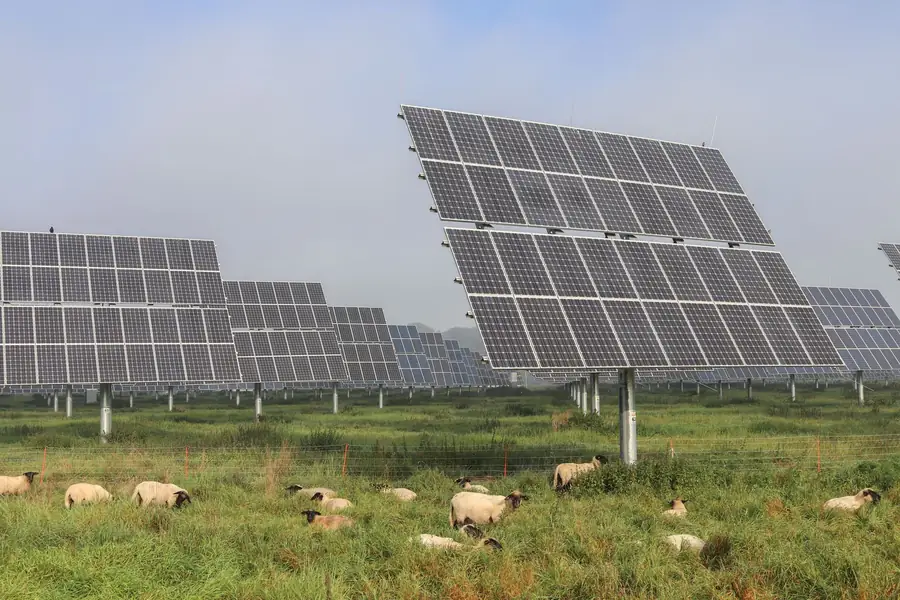
Nine square metres is a handful of panels. Any ground-mounted solar array on farmland or spare site land big enough to make a difference to a business bill needs a full planning application. Expect the council to look at drainage, access, ecology, views and neighbours. For a sense of scale, Salford City Council’s own 2MW solar farm on Kenyon Way in Little Hulton, switched on in March 2024, covers 3.8 hectares, which is a long way past anything Class K allows.
Car-park canopies are now easier. Class OA, added in December 2023, covers solar canopies over off-street, non-domestic parking. They can be up to 4 metres high and must be at least 10 metres from the curtilage of any house or block of flats. Prior approval is needed for siting, design, appearance and glare, and the work has to be finished within three years of approval. Our solar carports page explains how they’re built.
Battery storage has no permitted development class
This catches people out. Part 14 contains no class for battery energy storage. So while panels on your roof may be permitted development, an outdoor battery container next to them may not be.
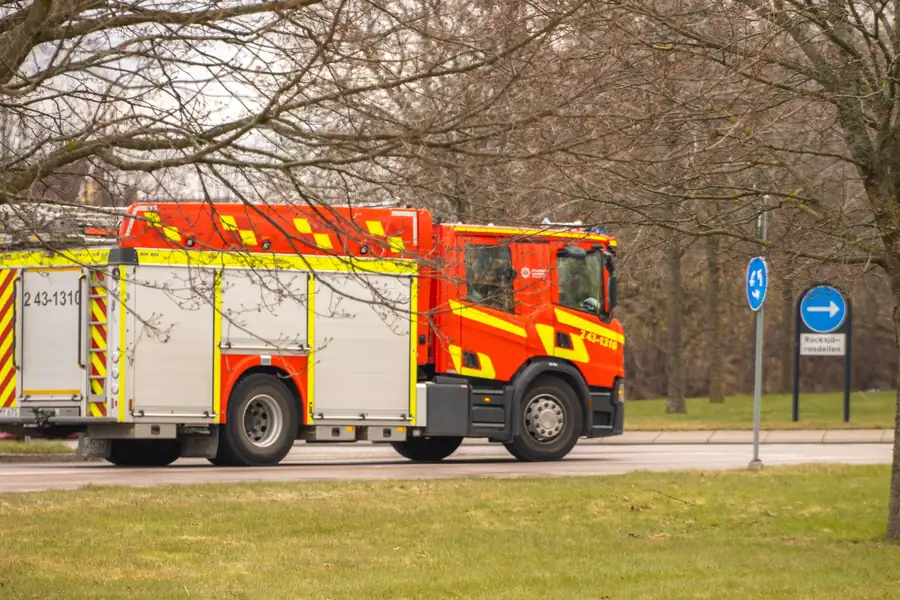
Government planning guidance added a battery storage section in August 2023. For systems of 1 MWh or more, it encourages applicants to talk to the local fire and rescue service before applying, and encourages councils to consult them. It also points to National Fire Chiefs Council guidance on siting and access. The government’s planning guidance on renewable and low carbon energy sets this out.
Whether a smaller outdoor battery on a commercial site needs a full application depends on the details, and we’d take planning advice rather than guess. A battery fitted inside an existing building is a different question again. If you’re still deciding whether storage is worth it at all, our guide on whether battery storage pays for a Manchester business runs through the numbers first.
Which council handles your application
Greater Manchester has ten councils, and each is its own planning authority. Postcodes don’t always help. Trafford Park has an M17 Manchester postcode but sits in Trafford.
For the areas we cover most often:
- Trafford Park: Trafford Council planning and building control
- Manchester, including Wythenshawe, East Manchester and Cheetham Hill: Manchester City Council planning
- Salford, including the Quays, Irlam, Cadishead and Agecroft: Salford City Council planning
- Bolton, Horwich and Westhoughton: Bolton Council planning
- Wigan and Leigh: Wigan Council planning and building control
Each council publishes its applications online, so it’s worth looking up what’s been approved near you. In Leigh, for example, Wigan Council was reported to have received a prior notification for a 200kWp roof-mounted system at The Range on Parsonage Retail Park. A neighbour’s approved scheme is a decent guide to what yours will face.
If your site sits close to an airport or airfield, mention it at the start. Glare is part of the prior approval test, and it’s simpler to show your layout has been thought through than to answer the question later.
Planning is one consent among several
A clean planning position doesn’t mean you’re ready to fit panels. Several other approvals sit alongside it, and some take longer than the council does.
The grid connection is usually the long one. Almost every commercial array needs a G99 application to SP Electricity North West, and the operator has up to 45 working days to quote for low-voltage works and 65 for high voltage. If you lease the building, the landlord’s consent will be needed for anything fixed to the roof. Your insurer should hear about the project before it starts. RC62, the joint fire safety code for PV published in 2023, was written with insurers and commercial rooftops in mind.
Then there’s the roof itself. If it’s fibre-cement or asbestos-cement, HSE rules on fragile surfaces and asbestos work apply, and you may decide to over-clad or replace it first. Under the Construction (Design and Management) Regulations 2015, your business also takes on client duties for the work. None of that is planning, strictly speaking, but all of it decides when the panels go on.
We check the planning position as part of every survey and tell you plainly which route your site needs. Ask us to check your site’s planning route
Frequently asked questions
Do I need planning permission for solar panels on my factory roof in Greater Manchester?
Usually not. Rooftop solar on non-domestic buildings is permitted development under Class J, provided it stays within the height and edge limits and the building isn't listed. Systems above 50kW need prior approval from the council on appearance and glare, which has 56 days to decide.
Is there still a 1MW limit on rooftop solar without planning permission?
No. The 1MW cap on non-domestic rooftop solar under permitted development was removed on 21 December 2023. Larger rooftop arrays still need prior approval from the local planning authority, but they no longer need a full planning application just because of their size.
Does ground-mounted solar for a business need planning permission?
Almost always. Permitted development for stand-alone solar on non-domestic land is limited to one unit of up to 9 square metres, no more than 3 metres in any dimension and 4 metres high. Any array large enough to matter commercially needs a full planning application.
Which council handles solar planning in Trafford Park?
Trafford Council. Trafford Park sits in Trafford borough even though it carries a Manchester postcode. Sites in Wythenshawe, East Manchester and Cheetham Hill go to Manchester City Council, Salford sites to Salford City Council, Horwich and Westhoughton to Bolton Council, and Leigh to Wigan Council.
Thinking about solar or a battery for your site?
Send us a year of half-hourly data and we'll tell you, in writing, what size of system makes sense and roughly what it would save. Manchester, Salford, Trafford, Bolton, Wigan and in between.