
Commercial Solar Panels In Manchester
Is your roof doing anything about the electricity bill yet?
Rooftop solar PV designed around the daytime load of factories, warehouses, offices and farms across Greater Manchester
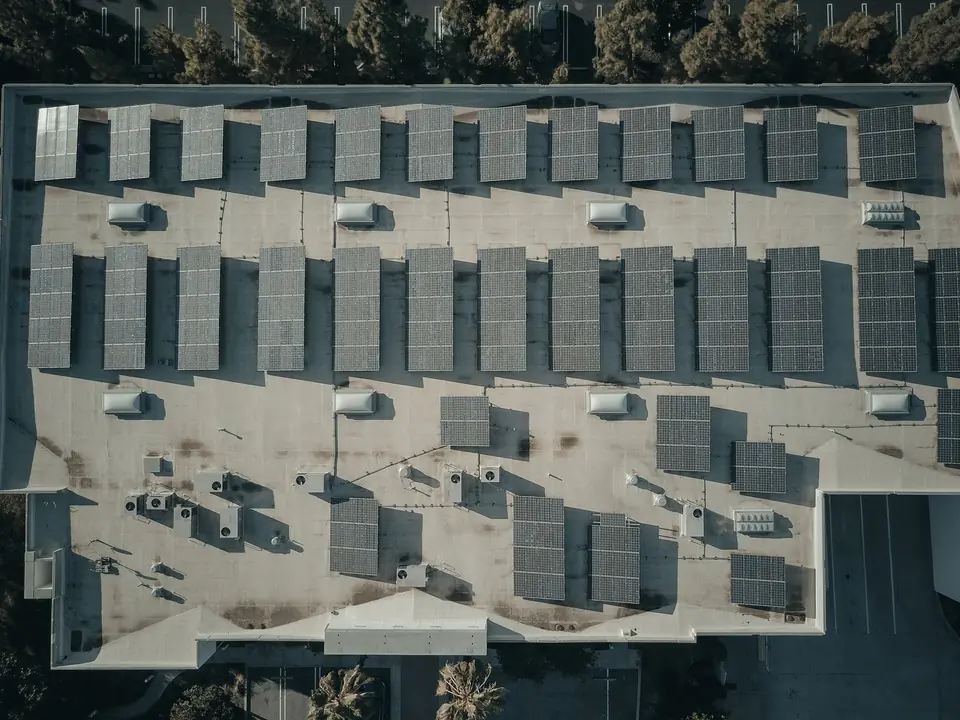
Commercial solar panels in Manchester pay back fastest on buildings that use most of their power in daylight. A production line running from seven until five, a chilled store, an office with its air handling on all afternoon: those loads sit under the solar curve, so the roof's output gets used on site instead of being sold back cheaply. The gap between the two is wide. DESNZ puts the 2025 average for a small business user (20 to 499 MWh a year) at 29.1p per kWh including Climate Change Levy, and export tariffs pay a fraction of that. We start with your half-hourly meter data and a proper look at the roof. Then we model what an array will produce here, which according to the EU's PVGIS tool is around 900 kWh per kWp a year for a well-pitched, south-facing system in Trafford Park. If the payback looks thin, the proposal will say so in writing.
Get A Free Solar Feasibility Check
We reply within one working day to book a site visit.
What rooftop solar does for a business balance sheet
The case for commercial solar in Manchester rests on a handful of numbers. Here they are, with the caveats we'd want a finance director to hear before signing anything.
01
Daytime units you no longer buy
Every kWh generated and used behind your meter is a kWh your supplier doesn't bill, along with the network charges and levies stacked on top of the wholesale price. That's why self-consumption matters far more than export. A site that soaks up nearly all its solar on weekdays sees the full retail value of each unit, while one that exports half its output earns a lot less per panel.
02
Capital allowances in the first year
HMRC classes solar panels as special rate expenditure. A company can claim the 50% first-year allowance on new kit, or use the £1 million Annual Investment Allowance, which covers most plant and machinery and often gives the faster write-off for a solar project. Which route suits your accounts is a question for your accountant, and we'll give them a clean breakdown of the costs to work from.
03
Business rates left alone until 2035
In England, plant and machinery used for onsite renewable generation, and storage used with it, is exempt from business rates from 1 April 2022 to 31 March 2035. Adding an array to your roof shouldn't push your rateable value up during that window. It's a smaller line than the energy saving, but it removes a cost that used to quietly eat into the payback.
04
A cap on what part of your power costs
The average non-domestic price in the DESNZ series was 13.8p per kWh in 2020, peaked at 27.2p in 2023 and sat at 24.5p in Q2 2026. Nobody can tell you where it goes next. Once an array is paid for, the units it makes have no unit price at all, so that share of your consumption stops moving with the market at each contract renewal.
05
Slow, measurable decline in output
Panels lose a little output each year. A widely cited NREL review of around 2,000 measurements found a median degradation rate of 0.5% a year, so a well-built array is still producing most of its original yield decades on. Inverters are the part that wears out first, and we budget for a replacement part-way through the system's life rather than pretending it won't be needed.
06
Output that peaks with summer loads
In Greater Manchester an array makes roughly 3.8 times as much in May, June and July as it does in December. That suits buildings with summer cooling, refrigeration or longer daylight shifts. It also means you should never size a system on a June afternoon. We model all twelve months against your consumption so the winter shortfall is in the numbers from day one.
£0
Site survey and a review of your half-hourly data
kWh
Systems sized from your own meter readings
G99
Grid application drawn up and submitted for you
M17
Based on Trafford Wharf Road, Trafford Park
What a Greater Manchester roof actually produces
Manchester's reputation for rain is mostly undeserved. The Met Office's 1991-2020 averages for Woodford, the nearest climate station to the south of the city, show 1,385 hours of sunshine a year against a UK average of 1,403, and 868 mm of rain against 1,163 mm for the UK and 1,338 mm for the North West and North Wales district. PVGIS puts a south-facing array at 35 degrees in Trafford Park at about 900 kWh per kWp a year. Lay the panels flat at 10 degrees and it drops to around 818. So a 100 kWp roof here will make something like 82,000 to 90,000 kWh a year, depending on how it's laid out.
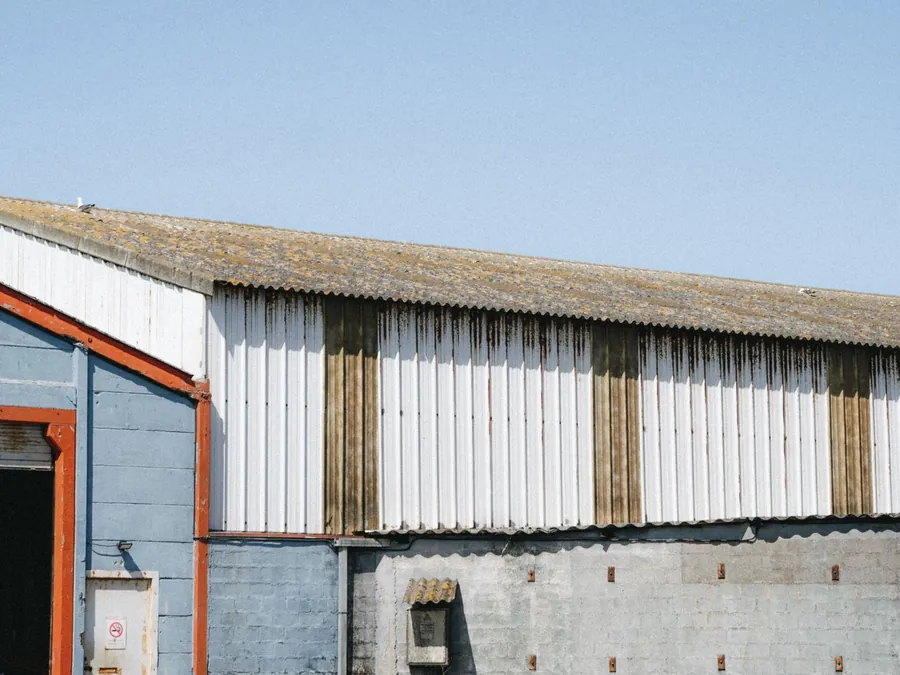
The buildings vary far more than the weather. There are Victorian and Edwardian mills, some listed and some inside conservation areas like Ancoats. There are mid-century steel sheds, many roofed in asbestos-cement sheet, which is fragile and needs a plan before anyone walks on it. And there are modern portal-frame warehouses along the M60, M61 and M62, from the older units on Trafford Park to the big sheds at Logistics North off junction 4 of the M61. Newer speculative warehouses such as Trafford150 now go up with panels already on the roof.
The local network belongs to SP Electricity North West, which was Electricity North West until it rebranded in August 2025. Anything over 16 amps per phase needs a G99 application, which in practice means almost every commercial array. On busier parts of the network the answer can come back with an export limit attached, and that changes how big the array should be.
"Most of the sheds we're asked to look at could physically take a bigger array than the building can use on a weekday, so our sizing conversations usually start at the meter, not the roof."
How a commercial solar project in Manchester gets from meter data to switch-on
- 1
Read the half-hourly data, then walk the site
We ask for twelve months of half-hourly consumption from your supplier or meter operator. It shows the overnight baseload, the weekend dip and when the building peaks. On site we look at the roof covering, how to get up there, where the main LV switchboard is and how far the cable will have to run.
- 2
Model the yield and put a proposal in writing
Using PVGIS irradiance for your postcode, we model output by orientation and pitch, then lay it against your half-hourly demand to split the yield into units used on site and units exported. The written proposal gives the system size, the equipment, the layout, the assumptions and a payback figure you can test.
- 3
Check the structure and apply to the DNO
A structural engineer checks that the purlins and frame can carry the extra load and the wind uplift. Fragile or asbestos-cement sheets are flagged at this point, not on install day. We submit the G99 application to SP Electricity North West and, if the array is over 50 kW, the prior approval request to your council.
- 4
Set up safe access and fix the mounting rails
Edge protection or scaffold goes up where it least disrupts the yard, with nets or staging over any fragile sheeting. Rails clamp to the seams of a profiled metal roof or sit on ballasted frames on a flat one, kept at least a metre back from the roof edge. Work is planned around your deliveries and shifts.
- 5
Fit the panels, inverters and cabling
Panels are wired into strings and run to inverters, usually mounted close to the switchroom to keep the AC runs short. DC cable routes and isolation points are agreed with you and your insurer, following the RC62 fire-safety recommendations, before the final connection is made to your main board.
- 6
Test, commission and notify the network
Each string is tested for insulation resistance, polarity and open-circuit voltage, and the AC side is inspected and tested to BS 7671. Inverter protection settings are checked against the G99 connection terms. Commissioning records then go to SP Electricity North West as the connection agreement requires.
- 7
Hand over monitoring, the O&M file and the export meter
You get a monitoring login, as-built drawings, test certificates and an operation and maintenance file. If you plan to sell surplus power, we make sure a half-hourly export meter with its own MPAN is in place, because an SEG payer won't accept estimated export. A maintenance schedule rounds it off.
Who answers for your Manchester installation, and for how long
There are two layers of cover on a commercial installation, and it pays to know which is which. The first is the installer's workmanship guarantee. It covers the way the system was put in: the fixings through your roof, the cable runs, the terminations, the protective devices and the commissioning settings. Its length and terms are written into the quotation, so you can read them before you sign rather than discover them afterwards.
The second layer belongs to the manufacturers. Panels normally carry a product warranty and a separate performance warranty, which promises a minimum output after a set number of years. Inverters and batteries have their own terms, often with cycle or throughput limits on storage. These vary by product, so every proposal names the exact models and attaches their warranty documents.
A guarantee is only as good as the install underneath it. That's why the structural check comes before the design is fixed, why every string is tested and recorded to BS 7671, and why the grid connection is commissioned to the settings SP Electricity North West has approved. If something we fitted fails because of how it was fitted, we come back and put it right.
In writing
Workmanship guarantee, set out in your quote
Per model
Manufacturer product and performance warranties
Test results, drawings, warranty certificates and the grid connection agreement are handed over in one pack on the last day.
What to look for in a commercial solar installer
They ask for your meter data before they quote a size
A quote that names a kWp figure after nothing more than a satellite image of the roof has been sized to the roof, not to the business. The two can be very different. A distribution shed with a large roof and a modest daytime load could end up exporting half its output for a few pence a unit, which stretches the payback badly. A good installer asks for half-hourly data, models self-consumption month by month, and is happy to show you how the export assumption was reached. If they can't explain where the saving figure comes from, treat it as a sales number.
They treat the roof as the first risk, not the last
HSE figures show falls through fragile surfaces, particularly fibre-cement roofs and rooflights, account for 22% of fall-from-height deaths in construction. Plenty of Greater Manchester sheds still have asbestos-cement sheets, and corroded metal sheeting can be just as weak. Your installer should survey the covering, bring in a structural engineer for loading and wind uplift, and tell you plainly if the roof needs over-cladding or replacing first. Since June 2026, MCS also requires structural, wind-loading and fire evidence on smaller installs where no certified mounting kit exists. That's a sensible bar for larger systems too.
They can explain the grid side and the insurance side
Most commercial arrays sit above 50 kWp, which is outside the MCS solar standard, so ask what the design does follow: BS 7671, the G99 process, harmonic assessment under G5 above 50 kW, and the RC62 fire-safety code for commercial rooftop PV that insurers refer to. A competent installer will tell you to speak to your insurer before work starts. They'll also explain whether an export limit under G100 is likely, and what your duties are as the client under CDM 2015.
Owning the array, a rooftop PPA, or carrying on as you are
Some businesses buy the system outright, some let a third party fund it under a power purchase agreement, and some decide to wait. The rows below cover the differences we're asked about most.
| Comparison point | Buy and own the system | Rooftop PPA (third party owns it) | Keep buying all power from the grid |
|---|---|---|---|
| Upfront capital | Yes, from your capex budget | Usually none | None |
| Price of daytime units | No unit charge once built | Set by contract, fixed or indexed | Reset at each supply renewal |
| Tax position (companies) | 50% FYA or the £1m AIA | Power bought as an operating cost | Power bought as an operating cost |
| Who maintains it | You, or an O&M contract | The PPA provider | Nothing to maintain |
| Contract tie-in | None beyond equipment warranties | Long term, with change-of-control terms | Supply contract only |
| Exposure to price rises | Removed for the solar share | Limited if the rate is fixed | Full |
When the roof isn't the right place for panels
Sometimes the roof rules itself out. The sheets are asbestos-cement and near the end of their life, the building is a listed mill, or the roof simply can't hold enough panels to cover the load. On sites like that we look at the car park and the spare land. Solar canopies over non-domestic parking have had their own permitted development class since December 2023, subject to prior approval, a 4 m height limit and a 10 m gap from any house.
Ground-mounted arrays are another route, though anything bigger than a single 9 m² unit needs a full planning application. Where the roof is worth saving, we can price over-cladding or re-sheeting alongside the solar so you see the whole cost in one place.
Read about solar carports for business car parks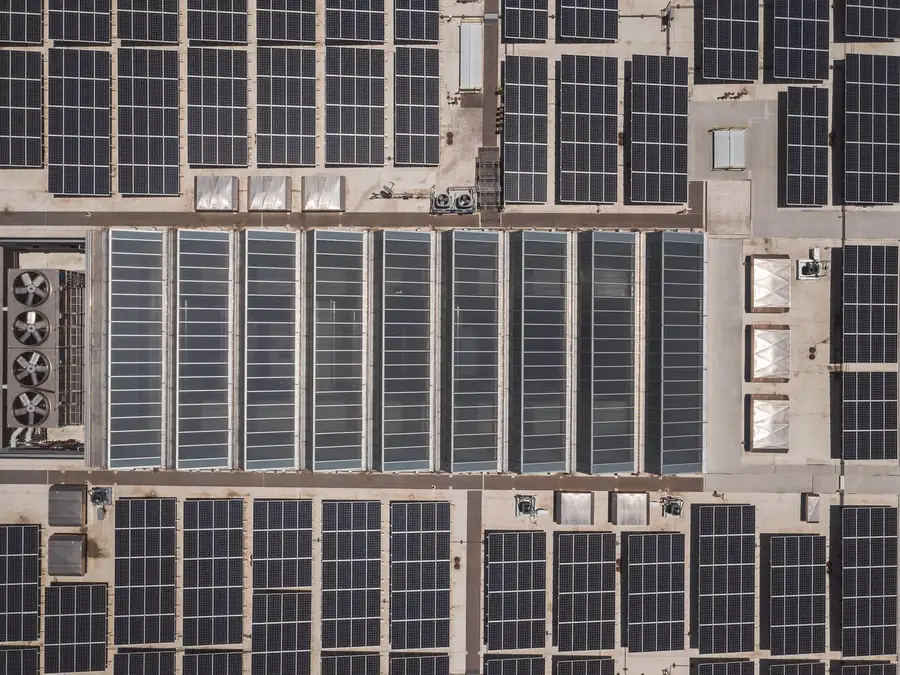
What commercial solar costs in Manchester
The best published guide is DESNZ's solar PV cost data for 2025/26, which is built from MCS records and so only covers systems up to 50kW. For 10-50kW installations the GB median was £1,204 per kW, and the North West mean was £1,248, including installation and grid connection. So a 40kW system comes to roughly £48,000-£50,000 as a rough guide. There is no official figure above 50kW, though the price per kW usually falls as systems get bigger. Roof works, scaffold and any network reinforcement are priced separately.
Commercial solar panels in Manchester: the questions finance and site teams ask
Do we need planning permission for solar panels on a commercial roof?
Usually not a full application. Class J of the permitted development rules covers rooftop solar on non-domestic buildings. Panels must stay at least 1 m from the roof edge and project no more than 0.2 m on a pitched roof or 1 m above a flat one. Arrays over 50 kW need prior approval from the council on appearance and glare, decided within 56 days, and the old 1 MW cap was removed in December 2023. Listed buildings are excluded, so a mill conversion goes to Manchester City, Bolton, Wigan or whichever council covers it for consent.
What is a G99 application, and will we be allowed to export?
G99 is the process for connecting generation above 16 amps per phase to the distribution network, which in Greater Manchester is run by SP Electricity North West. The network operator checks whether its local cables and transformers can take your export. Sometimes the answer is yes. Sometimes it's yes with an export limit, recorded in your connection agreement using a G100 form, and occasionally it's a reinforcement cost. The guaranteed deadline for a low-voltage generation quote is 45 working days, or 65 where high-voltage works are needed.
How is commercial solar treated for tax?
HMRC treats solar panels as special rate plant and machinery. A company paying corporation tax can claim the 50% first-year allowance on new equipment, and the remainder goes into the special rate pool. The £1 million Annual Investment Allowance covers most plant and machinery and is often the quicker write-off for a project of this size. VAT is charged at the standard 20% on commercial installations, which a VAT-registered business normally reclaims. Confirm the route with your accountant before you order.
Can we get paid for the electricity we export?
Possibly, but it isn't guaranteed. The Smart Export Guarantee covers solar up to 5 MW, but only suppliers with 150,000 or more domestic customers have to offer it, so a supplier that mainly serves businesses can decline. Rates are set by each supplier and must be above zero. You need a half-hourly export meter. For systems of 50 kW or less, the supplier will want MCS or equivalent certification of the installer and the installation, so check that before you sign with anyone.
Our roof is asbestos-cement sheeting. Can panels still go on it?
HSE's advice is to treat asbestos-cement sheets as fragile, and any work that breaks them up becomes notifiable. In practice the safer answer is often to over-clad the roof with a new metal skin, or replace it, before the panels go on. That adds cost, but it also resets the roof's life to match the array's. We survey the sheets and the structure first and price the roof works and the solar separately so you can see each part.
How much electricity will a commercial system in Manchester produce?
PVGIS, the EU's solar modelling tool, gives around 900 kWh per kWp a year for a south-facing array at 35 degrees in Trafford Park, about 818 at a flat-roof tilt of 10 degrees, and about 752 for the east-facing half of an east-west layout. Output swings with the seasons: roughly 30 kWh per kWp in January against 114 in May at the best tilt. A 100 kWp system will make somewhere between 82,000 and 90,000 kWh a year.
Related: Commercial battery storage · Solar maintenance and repairs · Commercial solar panel costs
What Manchester businesses say about us
We're a new name, so you won't find a wall of reviews here yet. We'd rather show you nothing than make some up.
For a project this size, reviews were never the best evidence anyway. Ask any installer you're considering for a reference site you can visit, a year or more of generation data from a system they fitted, and the grid connection paperwork from a past job. If they can't produce those, keep looking.
Commercial solar across Greater Manchester: pick your area
Send us a year of meter data and your postcode
That's enough for a first view of system size, yield and payback for your building. If the roof or the grid connection looks like a problem, you'll hear about it before you've spent anything.