
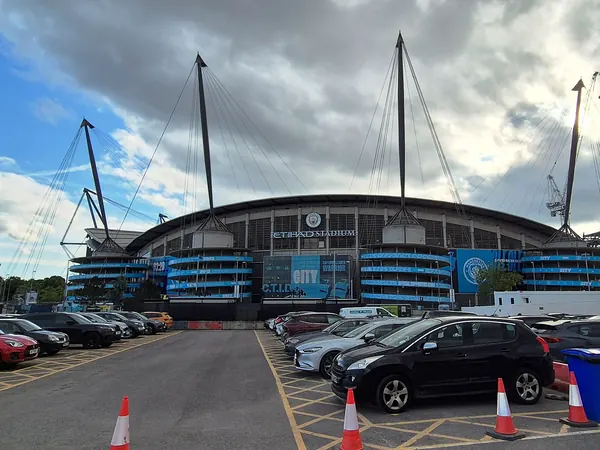
Etihad Stadium
Built for the 2002 Commonwealth Games and now Manchester City's home, the stadium at the heart of the Etihad Campus offers tours on non-match days.
Learn more about Etihad Stadium on Google MapsCommercial solar panels make an unusually tidy case in East Manchester, because so many firms here run heavy machinery in daylight. Press lines, CNC cells, compressors and extraction on the old engineering land around Openshaw and Gorton draw most of their power between the morning start and late afternoon, which is the window a south-facing roof covers. Each unit the array supplies on a working day is one you no longer buy, and DESNZ put the average business price at 27.7p/kWh for sites using 500 to 1,999 MWh a year in the second quarter of 2026. We size from your half-hourly meter data rather than from roof area, so the system follows the shift pattern instead of spilling cheap export on a quiet Saturday. On the older sheet roofs that are common east of the city centre, the structure and fragility get checked before anyone puts a price on paper.
We reply within one working day to book a site visit.
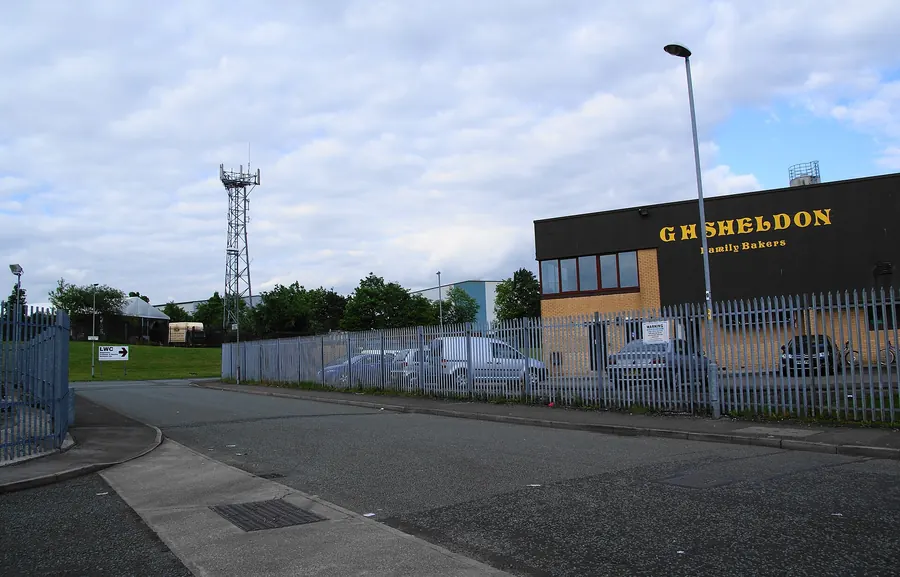
East Manchester earned its living from railways. The Gorton Locomotive Works, known locally as Gorton Tank, was finished in 1848 and turned out more than 1,000 steam engines before it shut in 1963. Across the line, Beyer, Peacock & Co set up its Gorton Foundry in 1854 on a 12-acre plot in Openshaw, and its railway work also ended in the early 1960s. The land that followed filled up with the kind of buildings we survey most here: steel-framed sheds and brick workshops on Kelbrook Road, units strung along Ashton Old Road, and owner-occupied premises where the same family firm has run machines under the same roof for decades.
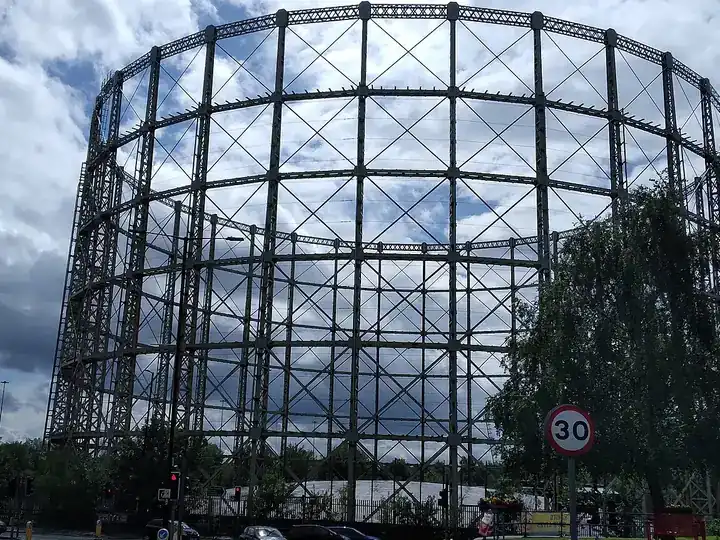
Further north the picture changes. Beswick and Eastlands sit around the Etihad Campus and the Bradford Road gas works, whose lattice gasholders still mark the skyline, and Newton Heath runs along the Rochdale Canal past Grimshaw Lane. Manchester City has been fitting more than 10,000 panels across the campus: 2,878 went onto the Joie Stadium roof by November 2024, with more on the First Team and Academy buildings and on canopies over the walkways. The Etihad Stadium itself is not part of that roof work. Two conservation areas, Newton Heath/Graver Lane and Gore Brook Valley, lie close to the industrial land but mostly not on it.
£0
Site survey and a review of your half-hourly data
kWh
Systems sized from your own meter readings
G99
Grid application drawn up and submitted for you
M17
Based on Trafford Wharf Road, Trafford Park
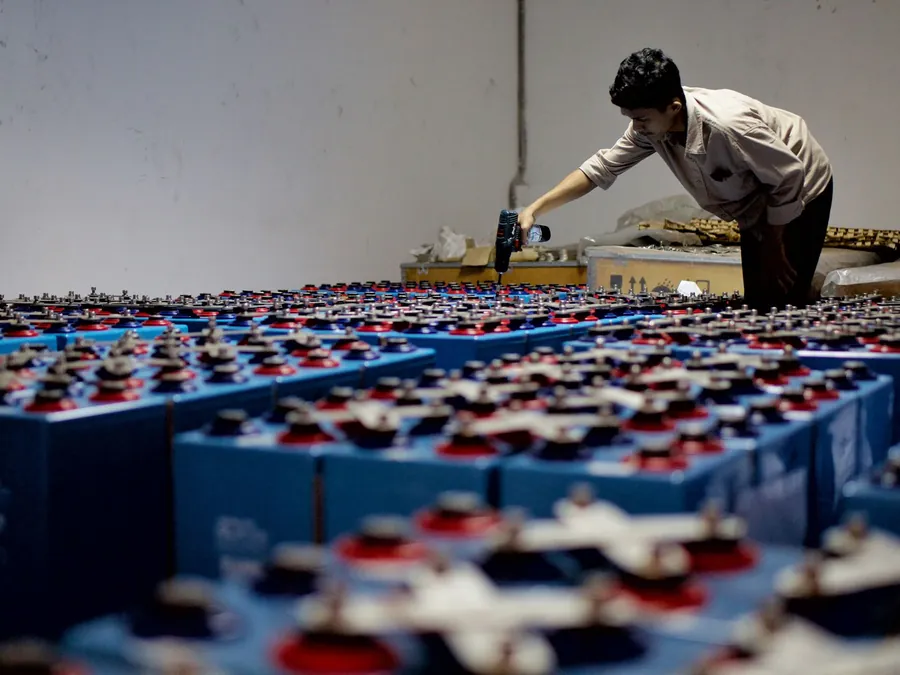
A battery sized against the weekday 16:00 to 19:00 red band and your agreed kVA, so the overlap between late shift and evening peak stops setting your bill. The East Manchester battery page shows how we model it.
Learn more about battery storage in East Manchester →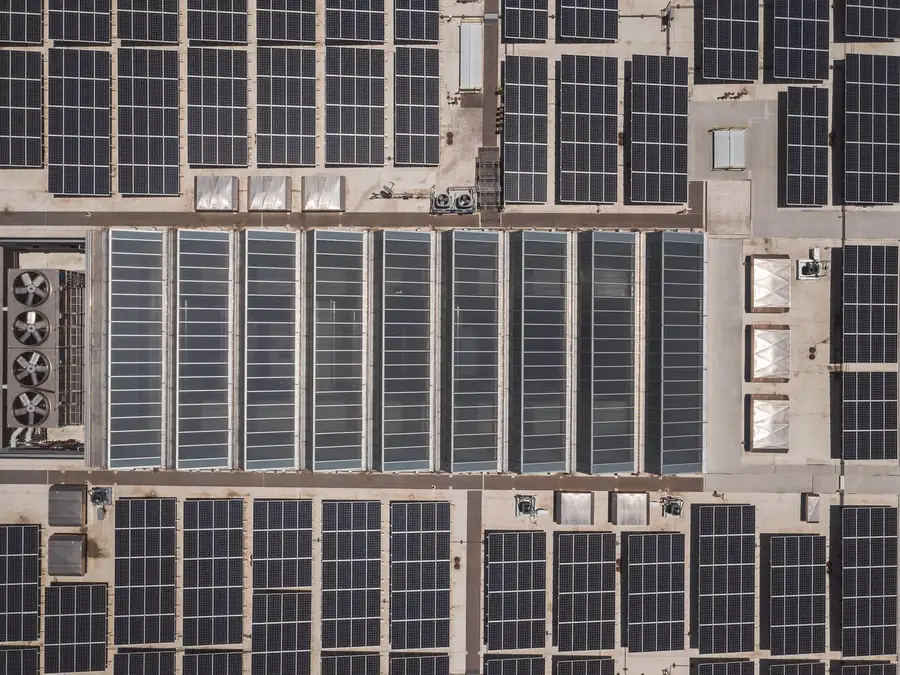
Rooftop arrays laid out around rooflights, extract fans and the bays of an older roof that cannot take extra load, wired back to a three-phase board and applied for under G99 with SP Electricity North West.
Learn more about commercial solar panels in East Manchester →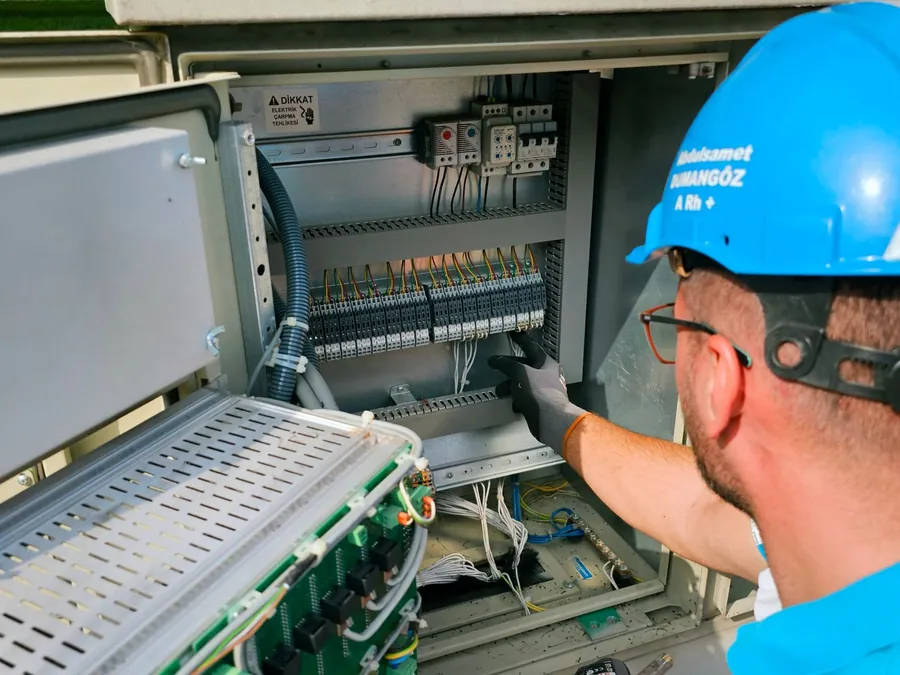
Works roofs gather grime from extraction outlets, and a tripped string can sit unnoticed for months while the inverter screen shows green. We inspect, clean, fault-find and test systems already running in the east of the city.
Learn more about maintenance & repairs in East Manchester →The common thread in Openshaw, Gorton and Beswick is daytime machinery on three-phase supplies. That shapes the business case far more than the size of the roof does.
A day-shift factory uses power at the same hours a roof generates it, so very little of the output leaves the site. PVGIS puts the May to July yield in Greater Manchester at roughly 3.8 times December's, and summer is when long days and extended shifts tend to coincide. Self-consumed units are the valuable ones, which is why the shift pattern decides the system size.
Export prices for businesses are set by each supplier, and suppliers that mainly serve non-domestic customers have no obligation to offer the Smart Export Guarantee at all. Set that against the 25p to 29p per kWh that DESNZ figures show small and mid-sized sites paying in 2026 and the conclusion is plain: design to use the power on site, and treat any export as a bonus rather than the plan.
Many East Manchester firms are owner-occupiers, which removes the slowest part of most commercial solar projects: waiting for landlord consent and agreeing who keeps the panels at lease end. It also means the asset sits on your own balance sheet, so the capital allowances position is yours to plan with your accountant from day one.
For tax, the panels on an Openshaw works fall into HMRC's special rate category. A company can claim the 50% first-year allowance on that pool, and the £1 million Annual Investment Allowance often gives a better result for projects under that figure. Batteries and inverters may be treated differently, so get your accountant to confirm the split before the order is placed.
In England, plant used for on-site renewable generation, and storage used with it, is exempt from business rates from April 2022 to the end of March 2035. For a works that has already absorbed a revaluation on its buildings, adding generating equipment to the roof without adding to the rates bill is a useful point in the calculation.
If you machine parts for larger manufacturers or bid for public-sector work in a city region that has committed to being carbon neutral by 2038, emissions questions turn up in tenders. A generation meter on your own roof gives you a measured number to quote, which carries more weight than a policy statement in an appendix.
"Most of the East Manchester works we're asked to look at already hold a year of half-hourly data that answers the sizing question - it just hasn't been read with a solar curve laid over the top."
There are two layers of cover on a commercial installation, and it pays to know which is which. The first is the installer's workmanship guarantee. It covers the way the system was put in: the fixings through your roof, the cable runs, the terminations, the protective devices and the commissioning settings. Its length and terms are written into the quotation, so you can read them before you sign rather than discover them afterwards.
The second layer belongs to the manufacturers. Panels normally carry a product warranty and a separate performance warranty, which promises a minimum output after a set number of years. Inverters and batteries have their own terms, often with cycle or throughput limits on storage. These vary by product, so every proposal names the exact models and attaches their warranty documents.
A guarantee is only as good as the install underneath it. That's why the structural check comes before the design is fixed, why every string is tested and recorded to BS 7671, and why the grid connection is commissioned to the settings SP Electricity North West has approved. If something we fitted fails because of how it was fitted, we come back and put it right.
In writing
Workmanship guarantee, set out in your quote
Per model
Manufacturer product and performance warranties
Test results, drawings, warranty certificates and the grid connection agreement are handed over in one pack on the last day.
We start with twelve months of half-hourly data so we can see when the shifts start, when the compressors kick in and how quiet weekends really are. Then we look at the roof from below and from safe access points, noting sheet type, rooflights and any obvious corrosion.
The array is sized so that most of its output is used during working hours. The written proposal gives the expected kWh, the share consumed on site, the assumptions behind the payback and the items still to be confirmed, such as structural sign-off and the connection offer.
A structural engineer checks that the trusses and purlins can carry the extra load. Fibre-cement sheets are treated as fragile until proven otherwise. In parallel we apply to SP Electricity North West under G99, including a harmonic assessment where the system is above 50 kW.
Scaffold, edge protection and any safety netting go up in an order agreed with your yard manager, so material deliveries on Ashton Old Road or Kelbrook Road units do not clash with your own lorries. Exclusion zones under the working area move as the job moves.
Mounting is fixed to the structure, never just to the sheet. Panels are strung to the inverters, and the AC run is taken back to your main low-voltage board along a route that avoids crane runways, extraction ducting and anywhere a forklift mast could reach it.
Each string is tested, the protection settings are checked against the G99 requirements and the installation is inspected to BS 7671. Switch-on is timed for a point in the day when a brief isolation of the board will not stop production.
You receive the test results, as-built drawings, isolation points and the monitoring login. We also give you what your insurer is likely to ask about, as RC62, the joint fire-safety code for PV, is written with insurers and their commercial clients in mind.
Built for the 2002 Commonwealth Games and now Manchester City's home, the stadium at the heart of the Etihad Campus offers tours on non-match days.
Learn more about Etihad Stadium on Google Maps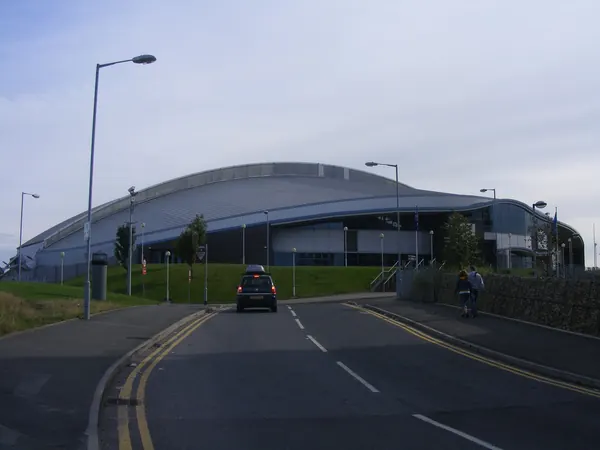
The Manchester Velodrome opened in 1994 as the home of British Cycling; the public can book track taster sessions and use the BMX centre next door.
Learn more about National Cycling Centre on Google Maps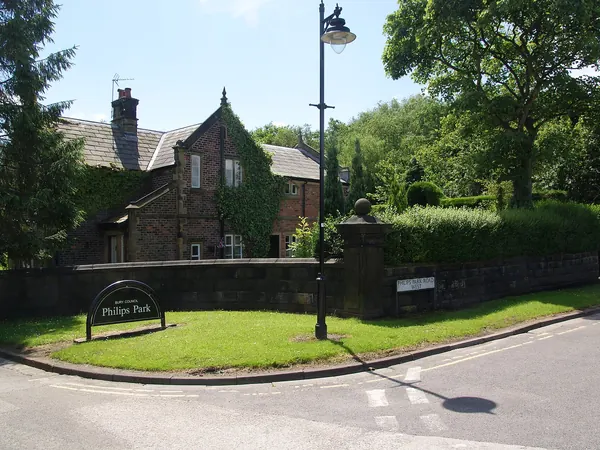
Opened in 1846 as one of the first municipal parks in the world, with woodland walks, a mountain bike trail and a quiet stretch of the River Medlock beside Alan Turing Way.
Learn more about Philips Park on Google MapsWe're a new name, so you won't find a wall of reviews here yet. We'd rather show you nothing than make some up.
For a project this size, reviews were never the best evidence anyway. Ask any installer you're considering for a reference site you can visit, a year or more of generation data from a system they fitted, and the grid connection paperwork from a past job. If they can't produce those, keep looking.
DESNZ figures for 2025/26 put the mean installed price of 10 to 50 kW systems in the North West at £1,248 per kW, and larger arrays usually come in lower per kW. On East Manchester sites the swing factors are mostly about the building rather than the panels. An asbestos-cement roof may need over-cladding or replacing first, mid-century trusses sometimes need strengthening, and on a sprawling works the cable run from roof to main board can be long. If the G99 offer includes network reinforcement, that is costed separately and we show it as its own line.
Usually not a full application. Rooftop solar on a non-domestic building is permitted development under Class J of the General Permitted Development Order, provided the equipment sits at least 1 m from the roof edge, stays within 1 m of the highest part of a flat roof or 0.2 m of a pitched one, and the building is not listed. Arrays above 50 kW fall under Class J(c), which needs prior approval from Manchester City Council on design and glare, decided within 56 days. Newton Heath/Graver Lane and Gore Brook Valley are conservation areas, so for a site inside either we confirm the position with the council before quoting.
Not straight onto it in most cases. HSE treats fibre-cement sheets as fragile, and falls through fragile surfaces account for 22% of fall-from-height deaths in construction. Drilling or walking sheets also risks damaging the asbestos, and if sheets would be substantially broken up the work becomes notifiable. The usual routes are over-cladding with a new profiled sheet or replacing the roof, then fitting the array to the new surface.
It can. Reactive charges apply when kVArh exceeds 33% of kWh in a half hour. Solar reduces the kWh you import but does nothing on its own to the reactive load from motors, so the ratio can rise after installation. We check this from your bills at the design stage, along with the G5 harmonic assessment required above 50 kW.
Distribution network operators have guaranteed standards for issuing generation quotes: 45 working days where only low-voltage work is involved and 65 working days for high-voltage work. The full connection timeline depends on whether reinforcement is needed, so we apply early, often before the structural report is back, and give you the network's answer as soon as it arrives.
We'll overlay a solar curve on your real demand and tell you how much a roof array would cover, and whether a battery is worth the extra. If the roof needs work first, you'll hear that before any figures.