
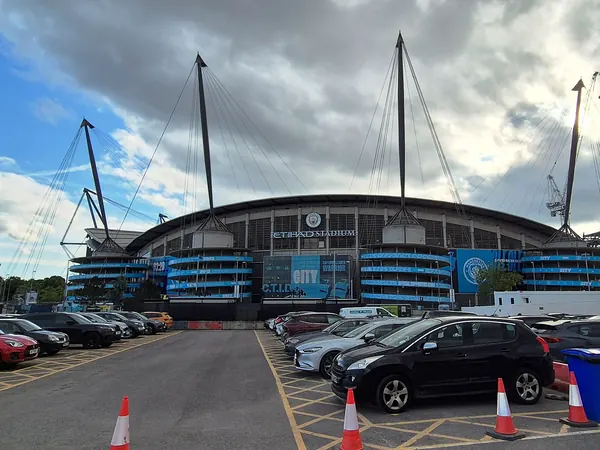
Etihad Stadium
Built for the 2002 Commonwealth Games and now Manchester City's home, the stadium at the heart of the Etihad Campus offers tours on non-match days.
Learn more about Etihad Stadium on Google MapsBattery storage is worth a hard look in East Manchester because of when the network charges bite. SP Electricity North West applies its red time band on weekdays, all year, from 16:00 to 19:00, and many factories in Gorton, Openshaw and Newton Heath are still running presses, ovens or a second shift through exactly those hours. For smaller aggregated sites the red DUoS rate is roughly six to ten times the amber rate charged earlier in the afternoon. The capacity side can sting harder: if a site goes over its agreed kVA, the excess is charged for the whole billing period, not just the half hour it happened in. A battery that discharges through those three hours, and steps in when demand spikes, deals with both. We model it against your half-hourly data before recommending any size.
We reply within one working day to book a site visit.
Storage on an industrial site earns its keep in a few specific half-hours. These are the mechanisms that matter on the works we see east of the city centre.
01
Charging in the green band overnight or from midday solar, then discharging between 16:00 and 19:00 on weekdays, moves your most expensive distribution units into the cheapest ones. On an LV site-specific tariff the 2026/27 red rate is 7.832p/kWh against 0.024p in green, before the energy part of the bill is counted.
02
Under the ENWL charging statement, any kVA above your Maximum Import Capacity is billed at the excess rate for the full billing period. A battery set to cap demand at a threshold below your MIC catches the moment when the furnace, the compressors and the welding bay all start together after a breakdown.
03
Raising your agreed capacity can mean reinforcement costs and a wait. Reducing it later is allowed only once in 12 months, and the capacity you give up may not come back without paying again. Covering short peaks from storage lets you add a machine and keep the MIC you already have.
04
A works that shuts on Saturday afternoon will export most of its weekend solar at whatever rate its supplier offers, if it offers one at all. With storage, that generation can be held over and spent into the next weekday red band instead.
05
Storage used with on-site renewable generation sits inside the business rates exemption that runs to March 2035. A battery used purely for trading power off the grid is not clearly covered, which is one reason we design East Manchester systems around a roof array rather than as standalone units.
06
MCS battery rules only cover systems up to 50 kW, so most commercial units are designed to the IET Code of Practice for Electrical Energy Storage Systems, whose third edition came out in 2024, and to BS 7671, whose Amendment 4 added a chapter on stationary batteries in April 2026.
£0
Site survey and a review of your half-hourly data
kWh
Systems sized from your own meter readings
G99
Grid application drawn up and submitted for you
M17
Based on Trafford Wharf Road, Trafford Park
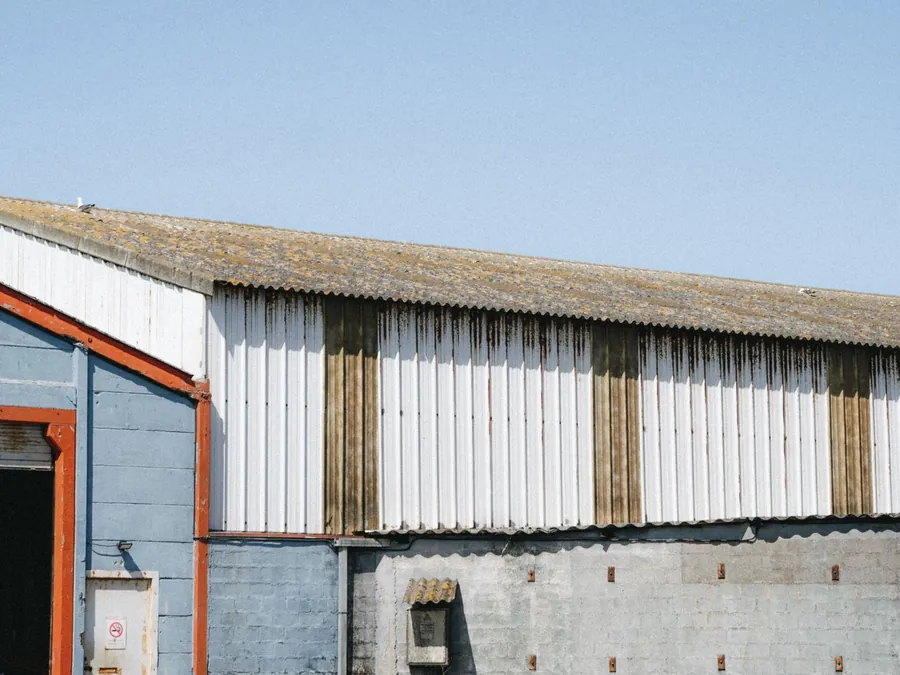
Industrial demand in East Manchester tends to be spiky rather than flat. Motor-driven plant, heat-treatment ovens and compressed air all draw heavily on start-up, and units along Pottery Lane or Ashton Old Road often share a supply that was agreed for a previous occupier with different machinery. That combination produces a bill where a few half-hours of high demand set the capacity cost for the month, which is exactly the problem a battery solves best.
Siting is the practical question on older plots. Some sites have a clear yard where an outdoor cabinet or container can sit with fire separation and access for the fire service, following the National Fire Chiefs Council guidance that planning advice points to. Others, packed tight against brick workshops, need a plant room solution instead. There is no permitted-development class for batteries, so we raise planning with Manchester City Council early.
If you are weighing up generation alongside storage, our page on commercial solar panels in East Manchester covers the roofs, yields and planning rules for the same patch of the city.
"Most of the peak-demand problems we're shown in East Manchester trace back to a handful of half-hours where start-up loads and the late shift overlap, rather than to a site that is short of supply all day."
We take a year of half-hourly readings and mark each red-band half-hour, each approach to your MIC and each reactive power spike. That tells us whether the battery is mainly a red-band tool, a capacity tool or both, which changes how it is sized.
Power rating sets how hard the battery can push in a peak; capacity sets how long it can keep going. A short spike at shift start needs a different ratio to three hours of red-band cover. The proposal shows both and explains the trade-off in money.
SP Electricity North West treats a battery as a generator, which means a G99 application for this one too. At the same time we agree a location with fire separation and access, and for systems of 1 MWh or more we encourage early contact with Greater Manchester Fire and Rescue Service, as planning guidance suggests.
Outdoor units need a level plinth clear of forklift routes and protected from impact. Indoor systems need ventilation and a fire-rated room. Cable routes back to the main board are planned so that trenching across the yard happens on a day your deliveries can work around.
Battery modules, the power conversion system, protection devices and the site controller go in, with current transformers on your incoming supply so the controller can see real-time demand and react before a peak becomes a breach.
We test the protection settings required under G99, check two-way protective devices and confirm the controller discharges when it should. If the connection agreement sets an export limit, we demonstrate that the limit holds before the system is handed over.
You get the documentation, isolation procedures and monitoring access. After the first billing periods we compare actual red-band and capacity figures with the model and adjust the dispatch settings if the shift pattern has changed.
There are two layers of cover on a commercial installation, and it pays to know which is which. The first is the installer's workmanship guarantee. It covers the way the system was put in: the fixings through your roof, the cable runs, the terminations, the protective devices and the commissioning settings. Its length and terms are written into the quotation, so you can read them before you sign rather than discover them afterwards.
The second layer belongs to the manufacturers. Panels normally carry a product warranty and a separate performance warranty, which promises a minimum output after a set number of years. Inverters and batteries have their own terms, often with cycle or throughput limits on storage. These vary by product, so every proposal names the exact models and attaches their warranty documents.
A guarantee is only as good as the install underneath it. That's why the structural check comes before the design is fixed, why every string is tested and recorded to BS 7671, and why the grid connection is commissioned to the settings SP Electricity North West has approved. If something we fitted fails because of how it was fitted, we come back and put it right.
In writing
Workmanship guarantee, set out in your quote
Per model
Manufacturer product and performance warranties
Test results, drawings, warranty certificates and the grid connection agreement are handed over in one pack on the last day.
Most firms here are choosing between three routes: carry on paying red-band rates and capacity charges, apply for more capacity, or put in storage. The table compares how each one plays out on a site with machinery that starts and stops through the day.
| Comparison point | Solar only | Solar + battery | Battery on its own (tariff shifting) |
|---|---|---|---|
| Solar used on site | Only what the load takes at the time | Higher: surplus stored for later | No solar involved |
| Red-band (16:00-19:00) costs | Little effect, almost none in winter | Cut with stored solar or overnight charge | Cut with overnight green-band charge |
| kVA capacity charges | No reliable effect | Peaks can be shaved | Peaks can be shaved |
| DNO export limit | Surplus above the cap is lost | Surplus stored instead of clipped | Cap applies to battery discharge too |
| Backup in a power cut | None as standard | Only if designed for it | Only if designed for it |
| Planning and permissions | G99; roof usually permitted development | G99; roof PD plus a siting and fire review | G99; no PD class, so take planning advice |
There is no reliable published £/kWh figure for commercial batteries, so we price each system from its specification. These are the factors that move the number most on sites east of the city centre.
A system built to clip short start-up spikes needs a high kW rating but modest kWh. One built to cover the full three-hour red band needs much more stored energy. Paying for capacity your demand profile never uses is the commonest way to overspend.
Older sites around Gorton and Openshaw were built up over a century, and yards are often tight against brick buildings. Where an outdoor unit cannot meet separation distances, a fire-rated internal room or a longer cable run to a clear corner of the site adds cost.
If the G99 offer allows only limited export, the battery controls are set to the G100 limit written into your connection agreement. That is cheaper than reinforcement in most cases, but the metering and control equipment is part of the price.
Adding storage to a solar system that is already installed may mean working with an inverter that was never chosen with a battery in mind. Sometimes an AC-coupled unit is the simplest answer; sometimes replacing an ageing inverter at the same time makes more sense.
Often, if the problem is short peaks rather than sustained high demand. A battery can hold demand below your agreed capacity during the moments it would otherwise go over. If your demand sits near the limit for hours at a time, storage alone will not fix it, and the data will show that before you spend anything.
That is common on older sites in Gorton and Openshaw. Options include a compact outdoor cabinet in a protected corner, a container on a cleared section of yard, or a fire-rated internal room. The choice depends on separation distances, fire service access and how far the unit sits from your main board.
Permitted development rights in Part 14 of the GPDO contain no class for battery storage, so we treat it as needing planning advice from Manchester City Council and, for an external unit, possibly an application. For systems of 1 MWh or more, planning guidance encourages early engagement with the fire and rescue service.
Yes. Batteries fall under the same G98 and G99 rules as solar. Commercial systems are almost always above the G98 threshold of 16 A per phase, so a G99 application is needed, and storage is exempt from some but not all G99 requirements.
Not by default. A grid-tied system disconnects when the network goes down, as its protection requires. Backup operation needs a specific design with switching to isolate your site from the grid, and it costs more. If short outages are causing you scrap or restart costs, tell us and we will price it as a separate option.
Built for the 2002 Commonwealth Games and now Manchester City's home, the stadium at the heart of the Etihad Campus offers tours on non-match days.
Learn more about Etihad Stadium on Google Maps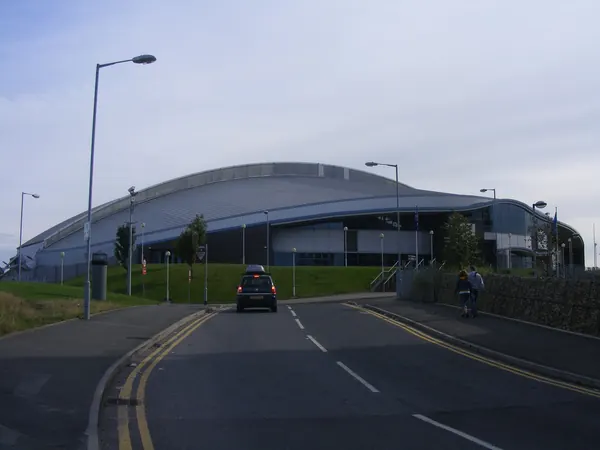
The Manchester Velodrome opened in 1994 as the home of British Cycling; the public can book track taster sessions and use the BMX centre next door.
Learn more about National Cycling Centre on Google Maps
Opened in 1846 as one of the first municipal parks in the world, with woodland walks, a mountain bike trail and a quiet stretch of the River Medlock beside Alan Turing Way.
Learn more about Philips Park on Google MapsWe're a new name, so you won't find a wall of reviews here yet. We'd rather show you nothing than make some up.
For a project this size, reviews were never the best evidence anyway. Ask any installer you're considering for a reference site you can visit, a year or more of generation data from a system they fitted, and the grid connection paperwork from a past job. If they can't produce those, keep looking.
Send us your half-hourly data and the last three bills. We'll show you how much of your red-band and capacity spend a battery could cut, and what size actually does it.